• Docs
  • Changelog
Sign in
Get started
    • Home
    • Your first deploy
    • Free instances
    • Platform features by plan
    • Use with coding agents
    • FAQ
    • Templates
      • Migrate from…
        • Heroku
        • Railway
    • Compute plans
    • SandboxesBeta
      • Service types
        • Which to use?
        • Static sites
        • Web services
        • Private services
        • Background workers
        • Cron jobs
        • Workflows
        • Multi-service architectures
      • Data storage
        • Render Postgres
        • Render Key Value (Redis®-compatible)
        • Persistent disks
    • How deploys work
    • Supported languages
    • Git providers (GitHub, etc.)
    • Build pipeline
    • Deploy hooks
    • Monorepo support
    • Troubleshooting deploys
      • Previewing changes
        • Single-service previews
        • Preview environments (multi-service)
      • Docker deploys
        • Overview
        • Deploy a registered image
        • Using secrets
      • Runtime
        • Native runtimes
        • Environment variables & secrets
        • Default environment variables
    • Intro to sandboxes
    • Limits
      • How to…
        • Create & configure sandboxes
        • Execute commands
        • Manage files
        • Manage snapshots
      • Use with…
        • Claude Managed Agents
        • Cursor Cloud Agents
        • OpenAI Agents API
      • SDK/CLI reference
        • TypeScript SDK
        • Python SDK
        • CLI commands
    • Intro to workflows
    • Tutorial
    • Limits & pricing
      • How to…
        • Define tasks
        • Define flowsNew
        • Trigger runs
        • Develop locally
      • SDK reference
        • TypeScript SDK
        • Python SDK
      • Example workflows
        • TypeScript examples
        • Python examples
    • Overview
    • Create & connect
    • Database credentials
    • Extensions
    • Version upgrades
    • Logical replication
    • Legacy instance types
      • Database recovery
        • Recovery & backups
        • High availability
      • Database performance
        • Read replicas
        • Connection pooling
        • Admin apps
        • Repacking tables
        • Troubleshooting performance
    • Regions
    • Inbound IP rules
    • Edge caching
    • WebSockets
    • TLS certificates
      • Custom domains
        • Overview
        • Cloudflare
        • Namecheap
        • Other DNS providers
      • Internal traffic
        • Private network
        • Private links
      • Outbound traffic
        • Default IP ranges
        • Dedicated IP addresses
        • Outbound bandwidth
        • Handling network changes
      • Static site config
        • Custom response headers
        • Redirects & rewrites
    • The Render Dashboard
    • SSH / Shell access
    • Projects & environments
      • Service actions
        • Scaling
        • Rollbacks
        • Maintenance mode
        • One-off jobs
      • Infrastructure as code
        • Blueprints overview
        • render.yaml reference
        • Terraform provider
    • In-dashboard metrics
    • Health checks
    • Uptime best practices
      • Logging
        • In-dashboard logs
        • Log streams (syslog/HTTPS)
      • OpenTelemetry (OTel) metrics
        • Provider setup
        • Metrics reference
      • Notifications
        • Webhooks
        • Email / Slack
    • MCP Server
      • Render CLI
        • Overview
        • Command reference
      • REST API
        • Overview
        • API reference
      • Third-party connections
        • OIDC support
        • Datadog
    • Workspaces, members, & roles
    • Login settings
    • Audit logs
      • Organizations
        • Overview
        • SAML SSO
    • DDoS protection
    • Platform maintenance
      • Compliance
        • Overview
        • HIPAA (US health data)
        • HIPAA best practices
        • Shared responsibility model
        • Pentest policy
    • Heroku vs Render
    • Vercel vs Render

Connect your Git Provider to Render

Deploy from GitHub, GitLab, Bitbucket, and Cursor Origin.

Render integrates with the following Git providers:

  • GitHub
  • GitLab
  • Bitbucket
  • Cursor Origin (beta)

After you connect your Git provider to Render, you can deploy services using any repository you have access to. Render automatically redeploys your service with every push to its linked branch (you can disable this).

Connecting your Git provider also enables pull request previews and provider-based sign-in.

Setup

Select the tab for your provider:

GitHub / GitLab / Bitbucket setup

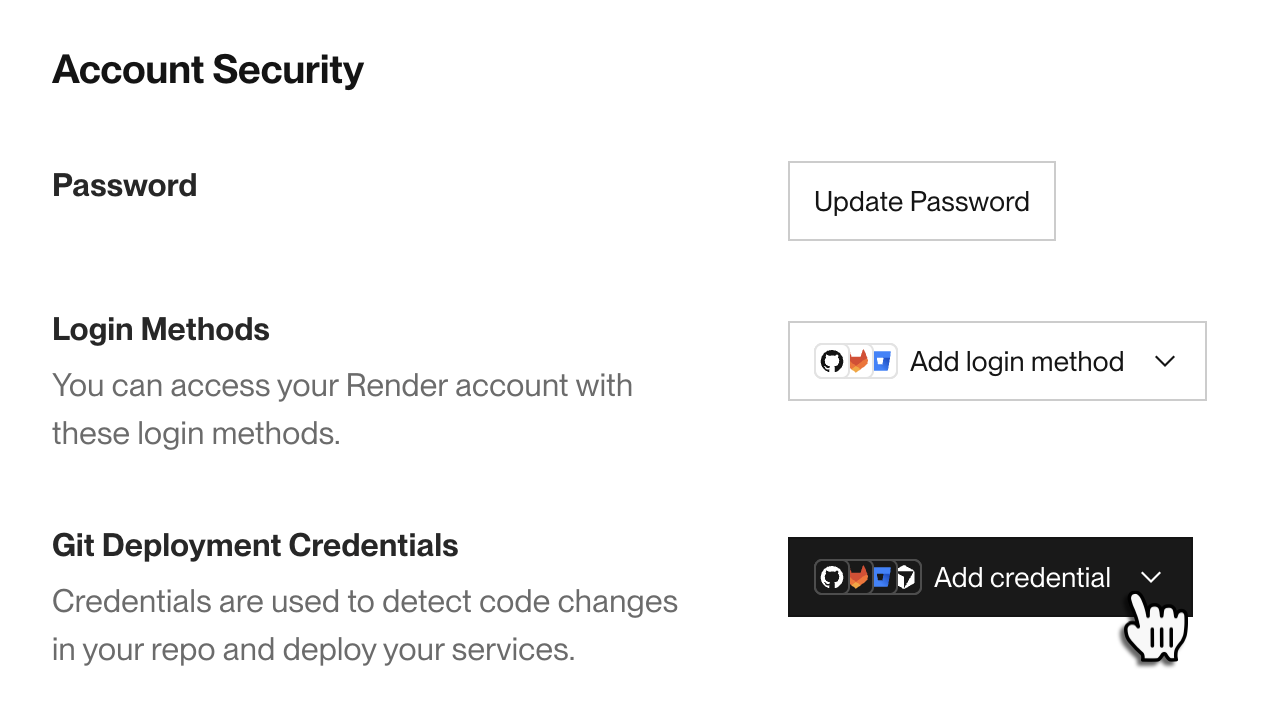
  1. Open your Account Settings page and scroll down to the Account Security section:
    Connecting your Git provider

  2. Under Git Deployment Credentials, click Add credential and select the Git provider you want to connect.

    This opens an authorization/connection flow with your Git provider.

  3. Review the details of the connection and confirm.

    • For GitLab, your account must have at least Maintainer or Owner permissions on a project to enable automatic deploys for it.

Cursor Origin setup

Cursor Origin and its Render integration are currently in beta.

A Cursor workspace admin must install the Render app before other members can connect. To install or connect to the Render app, do the following:

  1. Open your Account Settings page and scroll down to the Account Security section:

    Connecting your Git provider

  2. Under Git Deployment Credentials, click Add credential and select Cursor Origin.

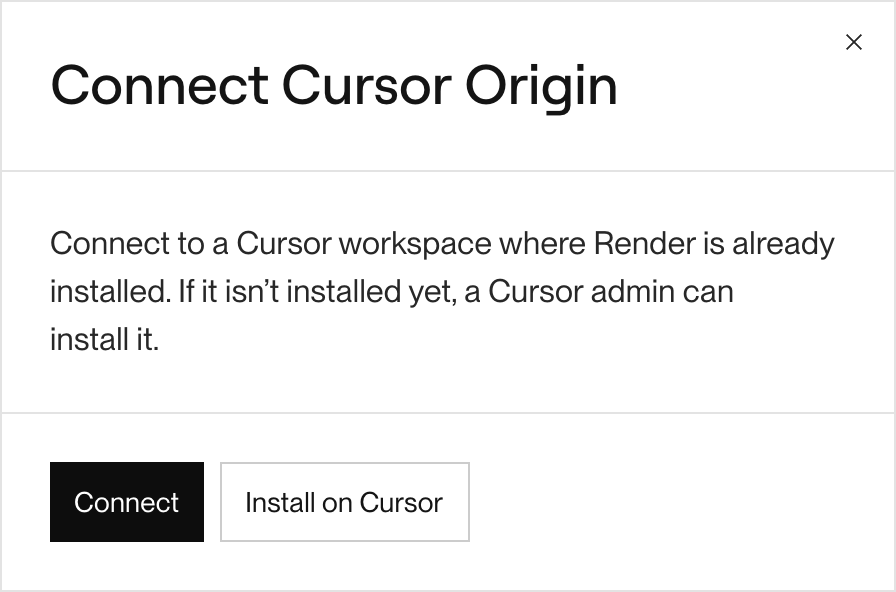
  3. Click the option that applies to you:

    Connect or install Cursor Origin in the Render Dashboard

    • Connect: Choose this option if Render is already installed in your Cursor workspace.
    • Install on Cursor: Choose this option if you're a Cursor admin and Render isn't installed in your workspace yet. Cursor prompts you to install the Render app.

You're all set! Whenever you create a service, you can link any repository from your connected providers:

List of connected repos in the Render Dashboard

Previewing pull requests

Render can automatically build and deploy a preview of your service for every pull/merge request opened against your service's linked branch:

Service preview in GitHub pull request

  • Every PR preview is deployed to a unique onrender.com subdomain.
  • Render redeploys a PR preview with every push to the PR's branch.
  • Render automatically deletes a PR preview when its PR is merged or closed.

Pull request previews work with all supported Git providers. For details, see Service Previews.

Signing in with your Git provider

Sign-in with Cursor Origin is not supported.

You can sign up for Render and sign in to the Render Dashboard with your GitHub, GitLab, or Bitbucket identity:

Logging in with your Git provider

If you already have a Render account that matches your Git provider account's primary email address, Render logs you in to the existing account automatically.

Learn more about managing login methods.

Git submodules

If your repository defines a .gitmodules file at its root, Render automatically reads it and clones all specified Git submodules as part of your service's build process.

Render attempts to clone Git submodules using the credentials associated with your connected Git provider. Private submodules must be accessible with those credentials.

Provider-specific details

GitHub details

Troubleshooting

If your GitHub deploys aren't working as expected, this might be caused by misconfiguration of Render's GitHub app. For example, it might be configured for the wrong set of repositories, or a repository that was previously public might have been made private.

Fixing GitHub app permissions

Visit github.com/apps/render/installations/new to install the Render app in a new organization or configure an existing installation:

Configure GitHub

From here, check the Repository access section to make sure your repository is included.

Selecting connected GitHub repositories

Team-specific issues

If the creator of a Render service loses access to that service's connected GitHub repository, it can disrupt deploys for that service. You can update the Git credentials used to deploy a service from the service's Settings page in the Render Dashboard:

Git Credentials

Before you make this change, make sure that the new credentials have access to the service's Git repository.

Cursor Origin details

Cursor Origin and its Render integration are currently in beta.

GitHub-mirrored repositories

Cursor Origin supports mirroring GitHub repositories. The following Render features are unavailable for mirrored repositories:

  • Automatic deploys
  • Pull request previews

To use these features, you can connect the original GitHub repository to your service instead of its Cursor Origin mirror.

Connect your Git Provider to Render
  • Setup
  • Previewing pull requests
  • Signing in with your Git provider
  • Git submodules
  • Provider-specific details
All Systems Operational
© Render Inc. All rights reserved.